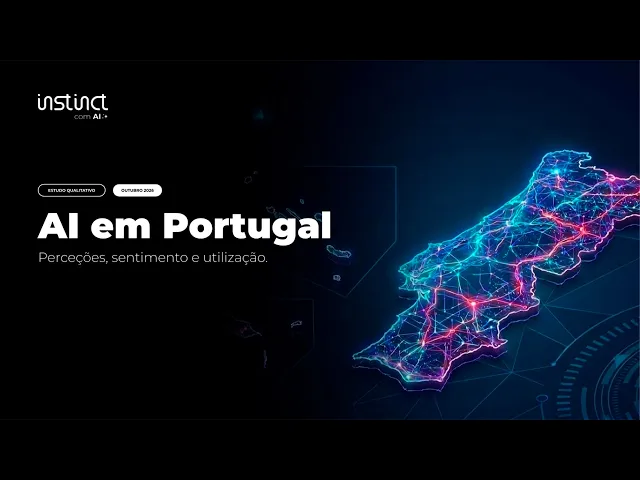
Study: AI in Portugal
PRESS RELEASE

The Portuguese accept AI.
They refuse decision-making without accountability.
Instinct publishes qualitative study conducted with artificial intelligence.
6 October 2026 — Instinct has published the study: AI in Portugal. The subject is the Portuguese: how they use, fear and accept artificial intelligence - and how they react to information, commentary and analysis on the topic. This qualitative study was itself conducted with AI, following the market research methodologies used by Instinct over 14 years.
It is not a poll. It maps language, tensions and conditions of acceptance.
The conclusion is clear. Artificial intelligence is a lever for those who have education, time and financial capacity. The conflict is social and economic, not technological.
The line running across the panel with different profiles
Automating repetitive tasks, with supervision and an identifiable responsible party, tends to be accepted. Automating life decisions - health, justice, assessment, employment - without a human responsible, is rejected.
The three main findings
Access is already a marker of inequality. Those with secure employment, literacy and the capacity to pay for tools accelerate and increase productivity. Those who do not are more exposed. Without training with time and investment, AI stops equalising and starts excluding.
At work, adoption is by the company; the onus is on the person who signs. Health, law, school and driving repeat the same desire: tasks, yes; decision-making, no.
The public debate fails at both extremes. The “10x professional” carries little conviction outside of those who already live that reality. Existential panic mobilises some and sounds like fear-mongering to others.
The television stress test
The study took place during the week that AI entered the dining room. On 13 September, Paulo Portas, on TVI, warned about the use of AI in creating biological weapons. On 16 September, Pedro Santa Clara, on RTP, criticised the alarmism and spoke of the “10x professional” — ten times more productive with AI.
Neither thesis wins over the panel. Both generate distrust, amongst different audiences. The irony is clear: the more technical profiles are suspicious of the extreme productivity framework; the less technical profiles do not feel safer when they hear “fear is manipulation”.
Those who report, comment and analyse AI for the Portuguese public will have more impact if they talk about opacity, employment and responsibility rather than paradise or apocalypse.
What this implies for
Companies. They survive internal scrutiny that adoption increases human capacity and they ensure a name is put to the decision. They gain credibility by planning training, they should avoid “10x” language with those living in precarity (it sounds like redundancy).
Media. Saying that “fear is manipulation” does not reassure those who are already suspicious. It increases the distance.
Public policy. The regulation requested is not a drag on technology. It is a drag on irresponsibility.
See the study in detail:
AI in Portugal study summary video:
Note:
This qualitative study was simulated by artificial intelligence, with 12 personas and 2 focus groups, designed according to the market research methodologies adopted by Instinct over the last 14 years. The final review was conducted by the Instinct team.
Over the last two years, Instinct has developed various market studies using artificial intelligence for its clients in different industries.
About Instinct
Founded in 2012, in Lisbon, Instinct was one of the first innovation consultancy agencies in Portugal. Inspired by companies of the new economy, it helps organisations achieve their best future version.
Press contact: hello@instinct.pt · www.instinct.pt